Search This Blog

Showing posts with label queue management. Show all posts

Saturday, June 11, 2016

Retailers: Improving Line Wait Time Improves Customer Satisfaction and Profits, Too

No one likes waiting in line -- whether at the DMV, grocery shopping, amusement parks or sporting events.  And, today, long wait times can be splashed across social media at any time.  That's in addition to lost profits when the customer balked or reneged and left the point of sale location.

Every retailer and entertainment venue constantly evaluates how to better improve the customer experience -- and improved line (or queue) management provides an immediate and long-lasting impact.  That's because effective line management technology offers more than just a shorter wait experience.
Enhanced Customer Satisfaction is the goal!

Automated line management provides at least 4 significant business benefits:
  1. Wait time management tools provide control -- Long-standing studies indicate average wait times can be reduced 10-30% with line management technology.  Lots of "fewer than 10 items" customers today?  Using automated management tools, store management is able to quickly realign registers to better serve those customers while reducing the number of "full service" registers.
  2. Improved line management -- Customers are more quickly and accurately directed to an open location as compared to "manually" guessing which station is available or casually strolling towards a register.
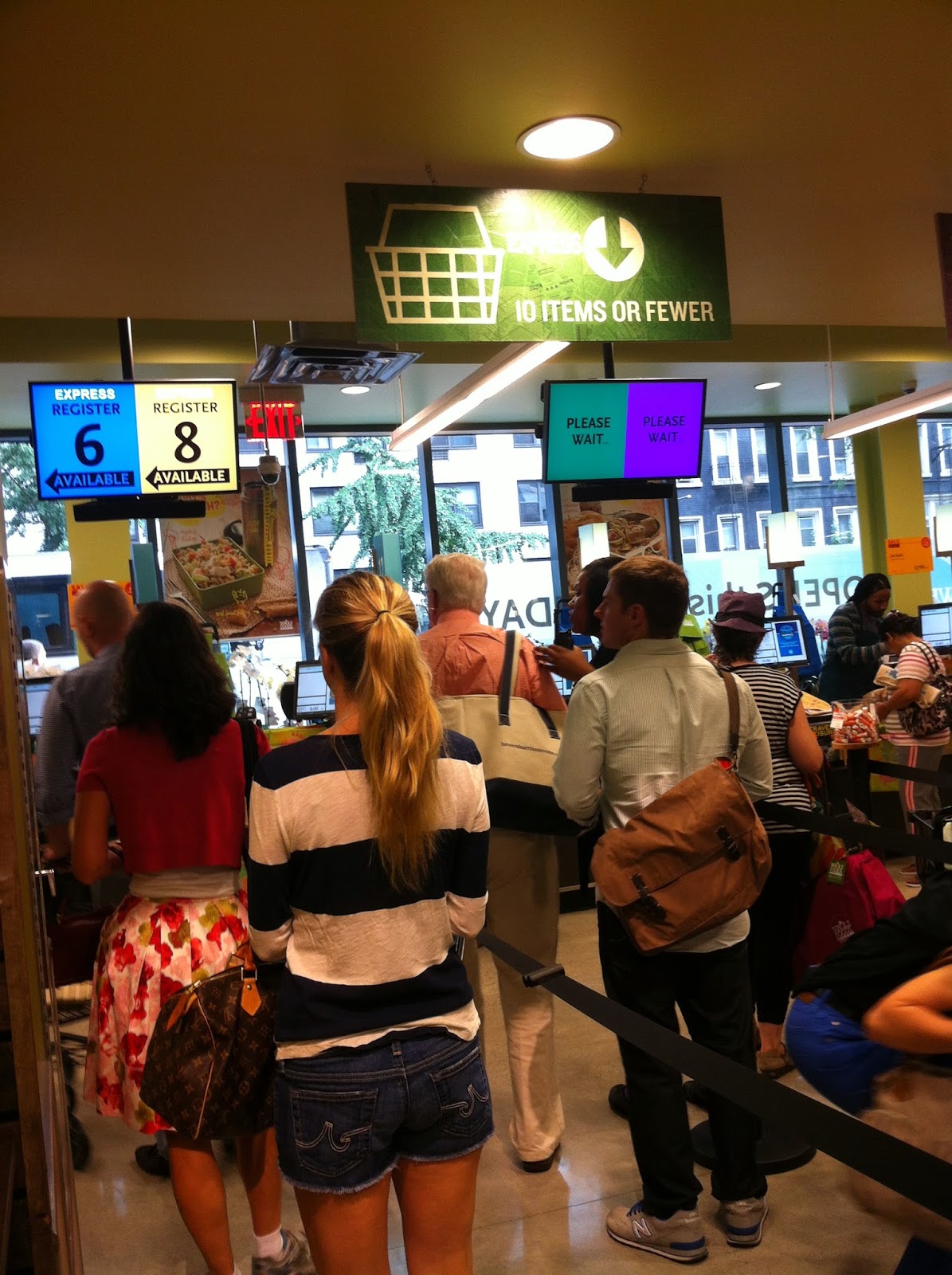
  3. Customer perceptions improve -- Two factors impact customer perceptions regarding lines: perceived wait time and the issue of fairness. Customers typically over-estimate the amount of wait time -- that's probably human nature. Providing an automated, call forward system not only efficiently directs customers to the next available register but encourages them to think the wait isn't as long as it actually is. Customers like knowing what is going on -- so seeing the next available register is beneficial even if it isn't their register!  And, people appreciate being treated fairly; an automated system is perceived as providing similar service to all.
  4. Expanded impulse purchase opportunities -- Whether an automated system operates a single, serpentine line or multiple, register-specific lines, the opportunity exists for expanding impulse purchase opportunities.  First, the business is regulating how and where the waiting zones are located. Additionally, customers are less stressed waiting so they're more likely to review offerings and make impulse purchases.  It's also possible to advertise and encourage such purchases through messaging on line management monitors. 

Interested in finding out more about how automated line management can improve your customer satisfaction levels and provide additional business benefits, too?  Talk to us at CPS about QuikLine -- an automated line management system providing call-forward technology with easy-to-use management tools and straightforward hardware components.


Wednesday, June 10, 2015

A Retail Checkout Line isn't for the Fainthearted

The retail checkout line is a critical aspect in a shopper's experience.  Some might think the consumer's "sale" is already finished when they enter a checkout line -- with just paperwork to be completed.

In reality, the sale could very well be lost just because of the checkout line!  There's always the chance of a consumer balking and reneging. And, if not this particular sale, future sales are at risk.

Perry Kuklin, writing in Business2Community, mentions a retail study indicating 38% of customers would consider not returning to a location with long or badly managed checkout lines; 81% will tell others, he says, about an unpleasant checkout line experience.

QuikLine: Call-forward Queue Management
And, when someone says "tell" others, we're no longer talking about one-on-one conversations, there's are all sorts of social media conversations available and ready to listen!

For retailers, the entire selling cycle needs to be completed -- from marketing to selection to actual purchase -- for the retailer and consumer to achieve success.  As a result, Queue Management becomes essential with customer wait time and experience critical.

Queue management technologies are available to assist in processing shoppers in a consistent and "fair" manner -- and they'll positively influence customer satisfaction as well as profitability.

Take a look at CPS' QuikLine system installed in Chicago -- shoppers are notified when a free register is available and directed by both signage and audio.  And, there's the ability to display automated marketing messages, as well.

QuikLine is an example of call-forward queueing which successfully manages customer throughput in the store and reduces register staff waiting.  Each successive customer is guided to an open register based upon either POS integration (that is, signals from the cash register process itself) or cashier notifications.  This checkout process is regarded as fair and efficient -- increasing the shopper's customer satisfaction!


Thursday, July 3, 2014

Retail Wait Warp: what can you do?

Retail wait warp? Is this some new Star Trek activity?

Not really, but...the term implies changing your retail customer's perception of their time in a checkout line.

No one likes waiting in line; that's something everyone agrees on. We can also agree that the checkout line experience heavily influences your customer's opinion of the entire shopping experience.

A recent Irisys blog notes, "People's perception of elapsed time when waiting is fairly accurate up to a minute and a half; after this point, they tend to over estimate how long the wait was."   In a sense, people's wait perceptions get exaggerated (one might even say warped!). Thus, it's even more important to proactively manage the experience.

There are a variety of methods to reduce perceived wait time. POS activity (messaging, for example) is a possibility -- as is having staff members interact with shoppers when possible.

Key, however, is a single file line -- or multiple lines with a specific target. A single line removes any question about who is next in line.Uncertainty generates anxiety -- and that anxiety negatively influences the experience. Multiple lines with a single target allow your shopper to select a line and know that it will be effectively managed, as well.

Managed lines maximize the wait warp as everyone senses the process is optimized. The wait experience itself is warped!

Talk to us here at CPS about QuikLine -- warp your retail stores with automated line management!


Tuesday, July 1, 2014

Tradigital Marketing: How You Can Maximize Results

Great Tanya Williams blog in DigitalSignageToday (you can read more here) pinpointing the paradigm shift underway regarding the way people consume marketing messages.

We've mentioned the transition from broadcast messaging to narrowcasting; at the same time, Williams suggests traditional marketing might be the conversation starter but digital is the new destination.

Traditional sales centers utilize interactive touchscreens
In other words, we can't think either/or.  It's not "traditional" vs. "digital" -- today's messaging needs to utilize the current and add digital to produce "tra-digital"  to generate better results.

What does this mean in real terms? Let's take a look at supermarkets as an illustration: you still see passive signage highlighting specials as well as weekly promo flyers.  No doubt your Sunday paper (if there is one!!) is filled with these flyers.

That traditional messaging is augmented by digital platforms such as point of purchase digital signage, automated line management systems and digital customer comment boards.

Point of Sales messaging + queue management
Williams highlights digital's ability to enhance the marketing message process (think: updated digital signage in minutes vs. printing, shipping, posting traditional signs) even as she combats "I can't afford to implement digital signage into my business" comments. Her "You can't afford not to!" response might sound a bit glib, at first.

Conduct a cost/benefit analysis, suggests Williams, and perform a competitive analysis, too.  What are your competitors doing? If you walk into your location, how does it compare to a tradigital one? Try a phased approach, she suggests; implement key locations first and tweak as you roll out. But...get started!!

CPS can assist you in this transition: our SalesTouch interactive touchscreen systems complement passive signage in sales/leasing centers; Customer Comment Boards are proactive customer service contact points and QuikLine manages  the "wait warp" inherent in busy retail locations.

Wednesday, May 21, 2014

Retail Line Queue Management: Disneyland Innovated in 1955!

Did you know there's a person known as a waiting lines expert?"

Actually, it's Richard Larson and he refers to the line management process as "queue calculus."
Both shopping carts and baskets are welcome!
Waiting in line," said Lewis in a recent article, "is a stressful game with mostly losing players and picking the wrong line can lead to queue rage."

Queue rage and simple economics are the reasons you see a "single serpentine line" in many retail locations.  Queue psychology was born in 1955 when Disneyland opened and learned to keep guests happy by having them wait in a single, serpentine line.  That's back when a 45-minute wait for a 2-minute ride was a novelty!

The single line satisfies the most number of people because it "guarantees first-come, first-served," says Larson. And, the single line can drive additional sales of "grab and go" items -- not just in grocery stores but other locations with easily understood and selectable items (as examples, think Best Buy, Marshalls and T.J. Maxx.).

Traditionally, grocery stores have been considered "hold outs" in this customer-service trend (emergency rooms are another hold out).

However, Whole Foods has proven to be an exception -- especially in large, metro areas.  As Larson mentions, their typical consumer "doesn't buy a week's worth of groceries for families." He continues, "You can fit those people into a serpentine line without wasting a lot of valuable sales space."

CPS' QuikLine queueing management system takes the process a step further -- multiple lines feeding a changeable register bank and the ability to differentiate between "express" and "standard" registers. Shopping carts are welcome, in other words!

Meeting your customer's needs, generating additional sales: queue management is an idea worth exploring!

.

Thursday, May 8, 2014

Queue Management Enhances Your Customer Experience

It's been said that "creativity can be time-consuming!"

So..in an effort to assist in the creative thinking process, here is an outside the box digital signage solution to help you differentiate your business and more effectively engage customers.

QuikLine: Improved wait time; enhanced customer experience
Everyone waits in lines...whether the grocery store, DMV, sporting events, big box retailers. 

Generally, few of us will report a good "line experience." As James Bickers, DigitalSignageToday.com's contributing editor reminds us, "The psychology of the customer experience says that when things are bad, it's noticed right away; but when things are good, they often go unnoticed."

When considering lines and looking to improve the customer experience, why not add digital signage to the queue?  Instead of having customers wait and wait and... add digital signage to the process to logically queue customers and send them to the first available location. And, while customers are waiting, engage them with messages, specials, images, too!

The effect: enhancing the wait process and reducing your customer's perceived wait time.  A win/win for this creative use of digital signage.  Technology enabled the task (better queue management) to be accomplished and your customer experience has improved, too.

Let us know if you'd like information regarding CPS' creative QuikLine solution tool -- effective line queue management software utilizing off-the-shelf hardware.

Thursday, August 9, 2012

Shopping & Queues: It's All About Customer Satisfaction

Pete Abila is on point in his May 14, 2012 blog, "What might seem like an obscure topic is actually one in which we are all affected: The Science of Lines."

Everyone has heard the horrors of DMV, airport, Christmas and amusement park lines.  They're long, they're boring, they close just before you get to the end!   We've probably all asked the question, "Isn't there something that can be done to improve this situation?"

QuikLine installation underway: Whole Foods 57th Street NYC
And, from the store/park/agency perspective, the "line" experience (or the "front") is crucial to customer satisfaction levels regarding their entire experience.  In other words, it doesn't matter (or matters less) that you found the bargain of the century if the check-out experience was lousy; the ride might be unbelievable but the entrance system was confusing and...you get the idea. 

Progressive Grocer sums it up pretty well, "75% of shoppers said a positive experience at the front of the supermarket makes their overall opinion of the store 'much better'."

That's a pretty significant number: 75% have a better shopping experience when the checkout process is perceived as good.  Another interesting comment is concern about check out time is so strong that many shoppers, upon entering, will glance at the front and base their shopping experience (time and related $$) on line conditions. 

Sometimes shoppers will "balk" after looking at lines (leaving the experience without a purchase) while some may wait in line for awhile and then leave without finalizing their purchase.  These behaviors are particularly bad news for a retailer: they were not only able to entice a shopper into their store (which took advertising, marketing, location and all sorts of other retail and financial components) but the shopper made positive purchase decisions only to lose the revenue because of a perceived (or actual) wait.

You're no doubt asking, "This should be a no brainer: why isn't the "front" experience better?"  There are several elements to this discussion and they range from mathematical and economics models to psychology:

(1) The tradeoff between cost and service in the "front" experience.  One might suggest a new cashier whenever someone new arrives to check out but..that's really not a reasonable solution given any sort of "cost/benefit" analysis.  There are ways to improve the equation, however!

(2) There are opportunities to implement queue management systems that notify shoppers when a new line is available, direct shoppers to the next available line and clearly identify closed registers.  These systems reduce many of the negatives associated with waiting such as the "unfair" line, questions about which line is faster, etc.

CPS' QuikLine provides all of those features with an administrative process allowing store employees to quickly/easily open new registers, assign registers to "express" categories and create messages.

QuikLine helps resolve a number of shopper "behavioral" concerns about waiting: "unfair" lines (e.g., "Why don't they handle returns in a special area?"); waiting seems longer longer when the end result is unknown ("I can't even see all the lines; some are around the corner or hidden") and "group" waiting's appeal ("I'd rather wait in a single line and know what to expect").

(3) The "wait experience" is capable of moving beyond "clock watching" when process improvements are made.  Why not make the waiting experience informative and/or a revenue opportunity?  It is possible to make a wait feel shorter by providing easy-to pickup items next to the line or running informative video, for example. There will be an immediate impact on both customer satisfaction and revenue!

Friday, June 8, 2012

Store Design: Maximize Shopper Experience and Sales, too!

We've talked about how much we read: newspapers, magazines, blogs, you name it -- keeping in touch with technology and trends so our software products and services meet today's business objectives and maximize their customer's experience.  From construction scheduling to sales management to interactive presentations..that's what we're trying to accomplish.

One aspect of technology that doesn't always get talked about is design -- the "behind the scenes" aspect of a piece of hardware or application.  Today's Wall Street Journal has an intriguing headline: 
Forget B-School, D-School is Hot!
 
The article goes on to talk about the "murky, problem-solving concept known as "design thinking."
QuikLine: Maximizing Shopper Experience and..Sales, as well!
Today, when folks mention design, they're not necessarily focused on traditional design -- or what we might think of as architectural or fashion design.  Today's design thinking is centered around observing people in order to evaluate processes.  That's where Apple has been so successful in capturing "new" design thinking: who knew how much we'd appreciate an iPad? Apple's designers do far more than draw iPad shapes; they consider an environment and suggest technology to satisfy generally unresolved (perhaps unknown) needs.

CPS' QuikLine moves into this new design paradigm with line (or queue) management.  Designers evaluate the habits of shoppers waiting in line.  We've all been there: the "wrong" line!  How can technology improve the shopping experience and, where possible, enhance the sales process as well?

It's been said that today's competitive retail environment is pushing the envelope to enhance the last stage of the purchase process: the checkout line.  Here's where "new" design resides!

No one likes waiting unnecessarily (so reducing "wait time" is a winner for both shopper and retailer!) but there are other components associated with improving the "last transaction" that designers have pointed out after studying shoppers: decreasing the number of "walk-aways", adding one or more "impulse buy" locations, and adding randomness to reduce register "no counts."

CPS' QuikLine was developed to provide several unique components to automated queue management: use of over-the-counter hardware (monitor, controllers, sound), integration with third-party applications (think: cash registers so QuikLine recognizes when a cashier is free), multimedia reminders (monitor, voice and display lights) and the ability to display  promotional video and messaging. 

Design initiated the thinking, technology delivered the solution!

Monday, October 10, 2011

CPS QuikLine -- up and running!

Have you ever really thought how much time you spend waiting in line?  Here at CPS, we've been thinking a lot about lines, queues, queue theory and how specially designed software and appropriate hardware can enhance the process.
Opening Day!  There was a lot to wait in line for!
It's been said that today's competitive retail environment is pushing the envelope to enhance the last stage of the purchase process: the checkout line.

The concept of "queue management" has emerged as retailers work to enhance the customer experience while improving store efficiency and generating additional revenue from their properties.  Completing the "last transaction" in a timely and engaging fashion is finally being recognized as an important aspect of the consumer shopping experience.

No one likes waiting unnecessarily (so..reducing "wait time" is a winner for both shopper and retailer!) but there are other components associated with improving the "last transaction" that savvy retailers recognize: decreasing the number of "walk-aways", adding one or more "impulse buy" locations, and adding randomness to reduce register "no counts."

CPS' QuikLine was developed to provide several unique components to automated queue management: use of over-the-counter hardware (monitor, controllers, sound), integration with third-party applications (think: cash registers so QuikLine recognizes when a cashier is free), multimedia reminders (monitor, voice and display lights) and the ability to display promotional video and messaging. 

First installation: done & we'll be talking more about it!